




The American Dream, according to Brittanica was the idea that the U.S. is the land of opportunity that allows the possibility of upward mobility, freedom, and equality for people of all classes. But how do you pursue that when the odds are stacked against you as a colored man in the South? You take the good with the bad and stand up for what is right.
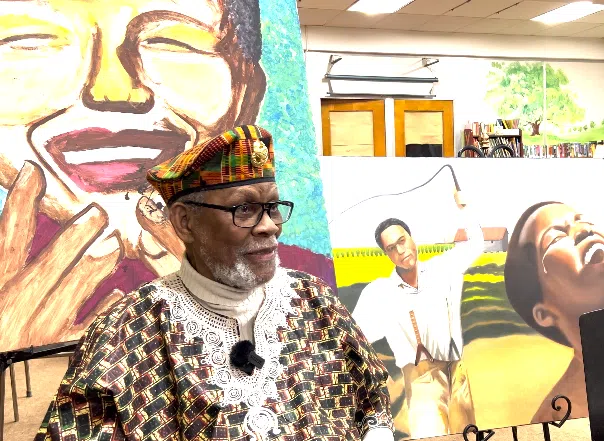
That there, is the very foundation and mindset that cultivated the well-rounded, determined, and honorable activist Johnny D. Holloway.
Born in Alabama and raised in Chattanooga, TN from three weeks old, Holloway says he was raised by a village and lived a normal life. He describes his upbringing as very disciplined.
“You had to do your chores. You had to go to school. You had to go to church. And then you had to finish high school.” As Holloway puts it, long before schools adopted the rule, “there was no pass, no play” rule in his home.
Everything was good up until Holloway says he found out he had been lied to at school.
The first lie came from a teacher who told him, ” Egypt is not in Africa but in Asia”.
The second lie happened during school integration efforts between City High School and The Howard School where Holloway was a student. On the visit, Holloway recalls seeing the word calculus on a board and as a math lover, he was immediately intrigued. However, he began to wonder why the course was not taught at his school and the reality was that his school did not have the prerequisite courses to do so.
“How can I compete with kids at the other school when they are learning different things than we are?” Holloway, initially puzzled, began looking into how the course could be added to the curriculum at his school. “I’m buying the American Dream; I’m accepting the separate but equal stuff”.
After multiple conversations with his school’s principal along with a few students, and many years later, the course was eventually added.
Of course, growing up in the South, experiencing segregation and racism was inevitable. For Holloway, he saw it in both subtle and sharp instances between the age of seven and eight years old. He says he remembers playing with both black and white children on a grassy hill one afternoon and for lunch he invited one of the white children home for lunch.
“I saw the expression on my mother’s face,” he says. She fed the child, but Holloway knew something was wrong. “That was my first experience with what was going on—the separate but equal thing.”
Another time Holloway remembers facing segregation was when he and his mother would make trips downtown and he saw two different water fountains, one marked ‘for whites’, the other ‘for colored’.
Out of curiosity, he sips the water at the fountain marked ‘for whites’.
“I said, I just want to know what the difference is in the water,” Holloway laughs. “Not that I knew of” any difference”, he adds.
Children, Holloway insists aren’t born with prejudice. “Kids are kids. They’re a clean slate. They don’t know all this stuff. They gotta learn all that.”
As Holloway got older, he became more interested in activism. But the fight for justice and equality came while attending college at Alabama A&M where he says he experienced his greatest culture shock.
“What I was expecting when I went to Alabama, was what I learned in Tennessee”, Holloway says as he remembers receiving his first ‘D’ in his entire academic career. This came from an orientation about how to “act in college “ as well as “how to treat white people, “ which he says he walked out of because that’s something his parents already taught him how to do.
From then on, Holloway was seen as a problem on campus by administrators. Being that he was part of the handful of out-of-state black students, whenever something went wrong, they were blamed. This made the next few years rough for him and Holloway decided that he was not going to just lie down and be treated any kind of way.
“If that’s the way y’all are going to treat us, I’m gonna show you what I would do if I were to do something”, says Holloway, who then began to organize a group addressing the unfair treatment.
After teaming up with another student, Holloway compiled a list of grievances and presented it to the University’s president. Those concerns went ignored, which then prompted the students to escalate the situation to a 10-day shutdown.
Eventually, the president agreed to address the grievances but Holloway demanded written proof. “If I go before the school board and say you said this and you said that, and then you don’t do it… who do you think they’re going to come after?”
It was his first lesson in protest strategy—and media misrepresentation. After telling reporters they would “strike Alabama A&M off the face of the earth,” newspapers twisted it into students threatening to “bomb” the school.
Following this, you can imagine Holloway still did not gain favor among school staff and they tried to get rid of him. While they couldn’t revoke his scholarship outright, they took his campus housing, and prevented him from graduating. Suddenly homeless, Holloway found refuge with someone who knew his father until he completed his studies.
” I don’t care too much for ceremonies anyway. All I want is a degree”, Holloway says.
Sometime after he landed a job when he left the university, he was able to receive his degree following the involvement of his employer at the time.
Not too long after, Holloway was drafted and joined the Air Force. Initially promised an engineering role, he was instead assigned to Air Police. “They lied to me,” he says bluntly.
After discovering he was eligible for a bypass test that could place him in his trained field, Holloway says he wrote to a few senators. The pressure worked. Instead of administering the test, they quietly transferred him into engineering.
During the remainder of his time in service, Holloway was responsible for addressing housing discrimination and mentoring young service members. There was one instance where he was able to change the rules at a skating rink from black people only designated to skate on one day a week to any time they wanted.
Upon leaving the Air Force, Holloway ended up getting a job with the Tennessee Valley Authority here in Chattanooga, TN.
Shortly after, he shifted focus to helping youth and continued fighting for fair treatment of African Americans in the community such as school teachers, minority employees at Erlanger Hospital, and a local McDonald’s. Soon, Holloway became the go-to guy for addressing injustice in the area.
He then got involved with local church leaders, joining the Unity Group, and later teaming up with the late Rev. Jesse Jackson’s Rainbow PUSH Coalition established in the 70’s. This was a national organization with a goal of fighting for both social and political change.
Following a visit from Rev. Jackson, Holloway went on the road with the reverend, eventually leading to him creating Chattanooga P.U.S.H Excel (People United to Save / Serve Humanity), a local chapter of the national organization. While the city already had multiple organizations, P.U.S.H was the one that both Jackson and Holloway saw as uniting and protecting the rights of our people.
“All these organizations are patches that can be made into a quilt. Operation P.U.S.H will be the thread to hold everything together and we will protect the Black Community”. A statement from Rev. Jackson Holloway reveals encouraged his leadership over the program.
P.U.S.H Excel focuses on young children, promoting education, and looks to identify their talents/skills which could be used to help their community. Holloway shares several principles the program was built upon, which is “get the attention of the kids, then you get the attitude, then you could change the altitude”.
Furthermore, the program is also meant to hold parents/guardians and educators accountable for raising children in the home and guiding them when they are in school or other settings.
Holloway is actively working to revive the program. He believes the program can promote education, instill in youth working for the good of the community and help elevate the minority groups within.
“Nobody will save us from us, but us,” Holloway emphasizes.
While this unique yet powerful program can surely transform our youth today, it won’t happen without participation from the community and it definitely won’t stop Johnny Holloway from shaping the future through our children.
From fighting for advanced math in segregated schools to organizing campus shutdowns, challenging discrimination in the military to mentoring youth, Holloway’s activism has always been rooted in dignity and strategy.
He never set out to be a headline. He simply refused to sit still when the rules of society did not make sense.
Today, Holloway’s story stands as a reminder that change doesn’t always start with a megaphone. Sometimes it starts with a simple request, a refusal to sit through nonsense. or a demand for something in writing.




Comments